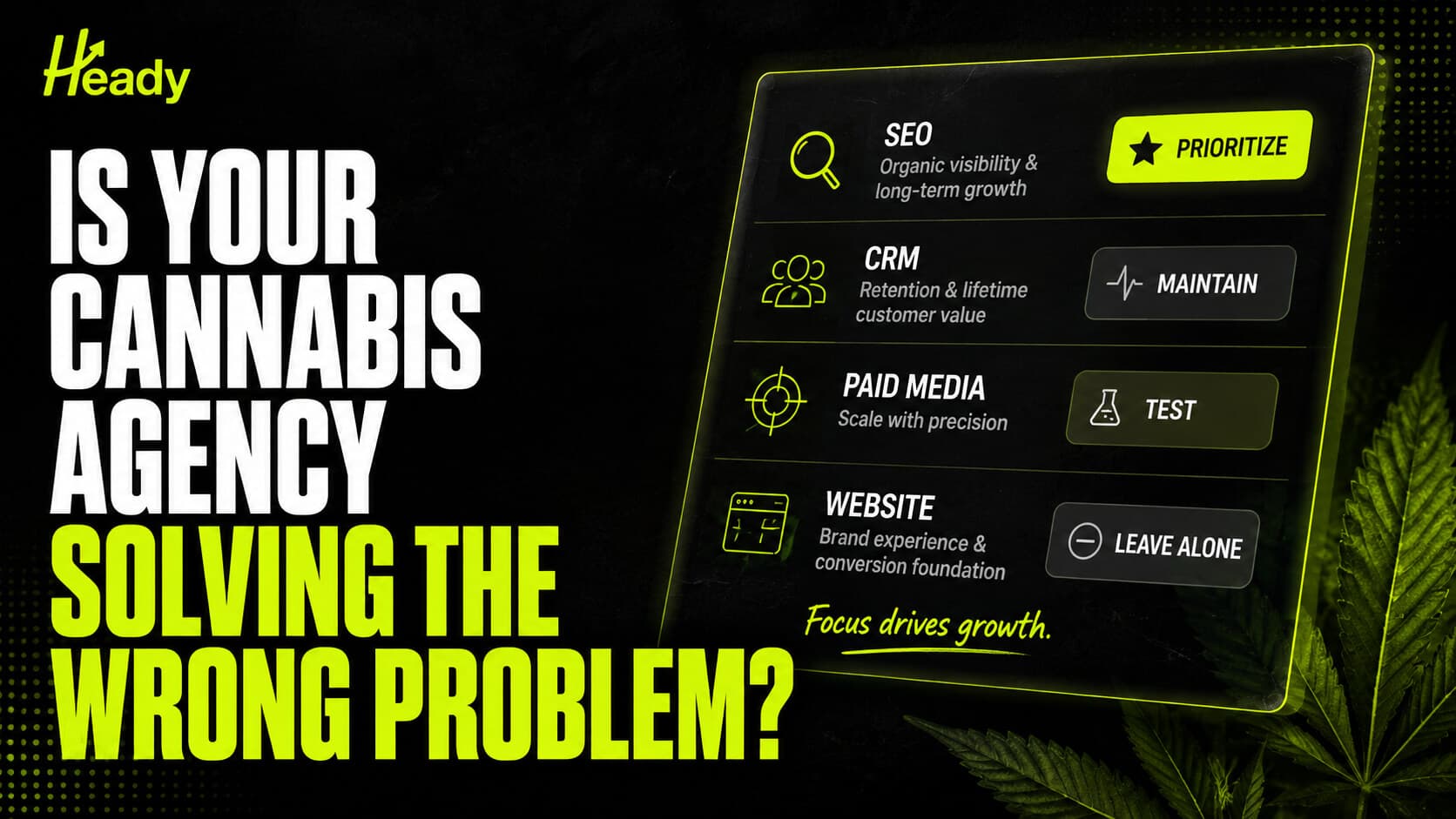
Ask an SEO agency what your cannabis brand needs, and the answer will probably involve SEO. Ask a paid media shop, and it’s ads. Ask a web studio, and there's a good chance the website is the problem. Ask a retention agency, and you probably need more campaigns.
That doesn't mean they're lying to you. It means most agencies diagnose problems through the services they already know how to sell.
Their toolbox shapes the diagnosis.
In cannabis, getting that diagnosis wrong can get expensive quickly. Mainstream advertising options are heavily restricted, margins are tight, loyalty is hard-won, and small differences in visibility, convenience, price, or product availability can move customers elsewhere.
So the first question shouldn't be, "Which marketing service should we buy?"
It should be, "Where is the biggest gap in the business right now, and what is the highest-leverage way to close it?"
Those are very different questions.
Three ways the traditional agency model can go sideways
The retention agency whose invoice never shrinks
Month one, they build your flows, segments, automations, campaign calendar, and templates.
Month nine, most of that infrastructure already exists. Now they're sending a couple of campaigns, tweaking subject lines, and swapping last month’s promo image for a new one.
The workload changed. The invoice didn't.
Retention work is naturally front-loaded. The initial build can be substantial, but once the system is in place, the account often shifts toward maintenance, testing, and ongoing campaign execution.
That work still matters. It just may not require the same scope forever.
But a recurring agency has very little incentive to say, "The hard part is done. You probably need less of us now."
Sometimes that is exactly the right recommendation.
The SEO agency whose highest-leverage work is already done
SEO has its own version of the same problem.
There is usually a real sequence of valuable work: fix the technical issues, clean up local listings, improve site architecture, build strong service and location pages, close meaningful content gaps, strengthen internal linking, and earn relevant authority.
Good work. Necessary work.
Finite work.
At some point, the obvious opportunities may be mostly handled. The website may already rank well for the most important terms. The local footprint may be strong. The next 20 blog posts may not move the business nearly as much as improving retention or fixing a weak market.
That is where an honest strategy should be able to say: maintain SEO, but stop treating it like the biggest growth lever.
Instead, the engagement can drift into more blog posts nobody was really asking for, another keyword report, or a refresh of pages that were already doing their job.
The client is still paying for growth work. The account has quietly moved into upkeep.
If the constraint is that nobody outside your own website vouches for you, the lever is PR and authority building, not another round of on-page tweaks.
The paid media agency that keeps the system mysterious
Cannabis companies have fewer mainstream paid-media options than most industries, which makes the channels that are available more important.
Programmatic. Retail media. Weedmaps. Leafly. Native placements. Market-specific opportunities. Different compliance rules depending on where you operate.
Some of that is genuinely complicated. But complexity can also become part of the retention model.
If platform access stays with the agency, reporting only arrives in screenshots, and nobody on your team understands how the campaigns are actually structured, switching providers becomes much harder.
That may be good for the agency. It is not necessarily good for you.
A strong partner should make the system more understandable over time, not less.
It isn't villainy. It's gravity.
The same force acts on almost everyone, including us.
An SEO specialist sees search opportunities. A designer notices the brand. A developer sees technical debt. A CRM person thinks about retention.
A good in-house marketer can do the same thing. The play that worked brilliantly at their last company becomes the starting point at the next one, even if the market, customer mix, and business model are different.
People reach for what they know.
We would too.
That is exactly why we stopped relying on the person selling the service to be the only person deciding which service matters.
Diagnosis should come before scope
At Heady, we try to separate those two decisions.
Before deciding whether a cannabis company needs SEO, CRM and messaging, paid media, a website, PR, content, or something else, we look at the business across the channels that actually affect customer acquisition and retention.
We call the resulting metric Share of Map.
Share of Map is Heady's metric for how much commercially valuable demand a cannabis company is capturing across its priority markets, categories, acquisition channels, and retention systems.
The methodology behind it looks at the combinations that matter to the business, such as category × market, then evaluates where the company is strong, where competitors are winning, and where the next dollar has the best chance of creating meaningful upside.
The analysis can pull from connected first-party data such as GA4, Google Search Console, POS, and CRM systems, along with external search and competitive data.
That forces us to answer questions like:
Where are consumers looking?
Where are you already visible?
Which category and market gaps are actually worth money?
Where are competitors winning?
What happens after you acquire the customer?
Which problems are worth solving now?
Which ones can wait?
A gap can exist without being worth paying someone to fix.
That distinction matters.
Sometimes the answer is "don't hire us for that"
This is probably the best test of whether the diagnosis is actually independent.
If your website is fast, usable, and converting well, we don't need to sell you another website. If your CRM program is strong, we should say so. If search visibility is already close to the realistic ceiling in your priority markets, another large SEO scope may not be where the next dollar belongs.
And if there are five things we could improve but only two of them have meaningful commercial upside, those two should get the budget.
A useful diagnosis should be capable of reducing the amount of work an agency gets paid to do.
Otherwise it isn't really independent.
That principle has to show up in the recommendations, not just the marketing copy. Sometimes the right answer is to leave a website alone, maintain a channel instead of expanding it, or shift attention toward a weaker part of the customer journey rather than selling more of something that is already working.
The point isn't that every engagement should get smaller.
It's that the scope should be allowed to get smaller when the data says it should.
"But you sell all of those services too"
Fair question.
We do SEO, web, CRM, paid media, content, PR, social, and analytics. So yes, we have a pretty big toolbox.
The difference isn't the size of the toolbox.
It's who decides which tool comes out.
The recommendation is supposed to come from the diagnosis, not from which team has capacity this month.
A Share of Map assessment might come back looking something like this:
Area | Diagnosis | Recommendation |
|---|---|---|
Website | Strong UX, speed, and conversion path | Leave it alone |
SEO | Significant opportunity in high-intent local and category searches | Prioritize |
CRM | Good foundation with healthy lifecycle coverage | Maintain, don't rebuild |
Paid Media | Worth testing in two priority markets | Pilot selectively |
PR | Limited short-term upside | Deprioritize |
That is more useful than six departments each explaining why their service matters.
And if the right scope gets smaller because the data says less work is needed, the invoice should get smaller too.
We give you the playbook either way
There is another good test of agency incentives:
What happens if you don't hire them?
Our answer is that you should still leave with something useful.
We build a custom plan around the gaps we think matter, what we would prioritize, and why. Then you have three options.
Have us run it
We execute the parts where you actually need help.
Not every discipline. Not a bundled retainer just because those services exist. The scope follows the diagnosis.
Run it yourself in HeadyOS
If you already have a capable internal team, you may not need a traditional agency.
HeadyOS gives teams access to the same operating system, data, playbooks, and decision framework so they can run more of the work themselves.
That makes the DIY option a real option, not a polite line at the bottom of a proposal.
Take the plan
You can also take the recommendations and execute them yourself.
No requirement to hire us afterward.
That might sound like a strange sales strategy for an agency. We think it is a healthier one.
Marketing should follow the opportunity
The traditional sequence often starts with the service: you need SEO, a new website, CRM, paid media, or something else.
We think the sequence should be reversed.
Start with the business. Find the biggest gap. Estimate what fixing it is actually worth. Then choose the tool.
Scope should change over time too. If SEO does what it was supposed to do, the SEO budget might shrink. If retention becomes the constraint, the budget should move there. If the website is doing its job, it should not become a redesign project simply because the web team exists.
You don't need a five-channel retainer because an agency has five departments. You don't need a rebuild because the web team has availability. And you don't need another year of the same scope simply because the first year worked.
Marketing should follow the opportunity, not the agency's org chart.
The job of the strategy is to make that opportunity clearer. The job of the agency is to execute against it well.
Those are separate jobs. We think separating them makes both better.
Get the unbiased version
We'll build you a free Share of Map plan showing where you stand, where we see the biggest opportunities, and the few things we would prioritize next.
If that means working with us, great. If your team can run it in HeadyOS, we'll tell you. If part of your marketing should be left exactly as it is, we’ll tell you that too.
Get your free Share of Map plan.
Frequently Asked Questions
How do you choose the right cannabis marketing agency?
Start with an agency that can explain how it decides what you actually need before it starts selling services. Look for a transparent methodology, access to your own data and platforms, cannabis-specific experience, and a willingness to tell you when a service is not worth prioritizing.
What is Share of Map?
Share of Map is Heady's metric for how much commercially valuable demand a cannabis company is capturing across its priority markets, categories, acquisition channels, and retention systems.
The methodology combines first-party and external market data to identify where a company is strong, where it is losing ground, and which opportunities are worth prioritizing.