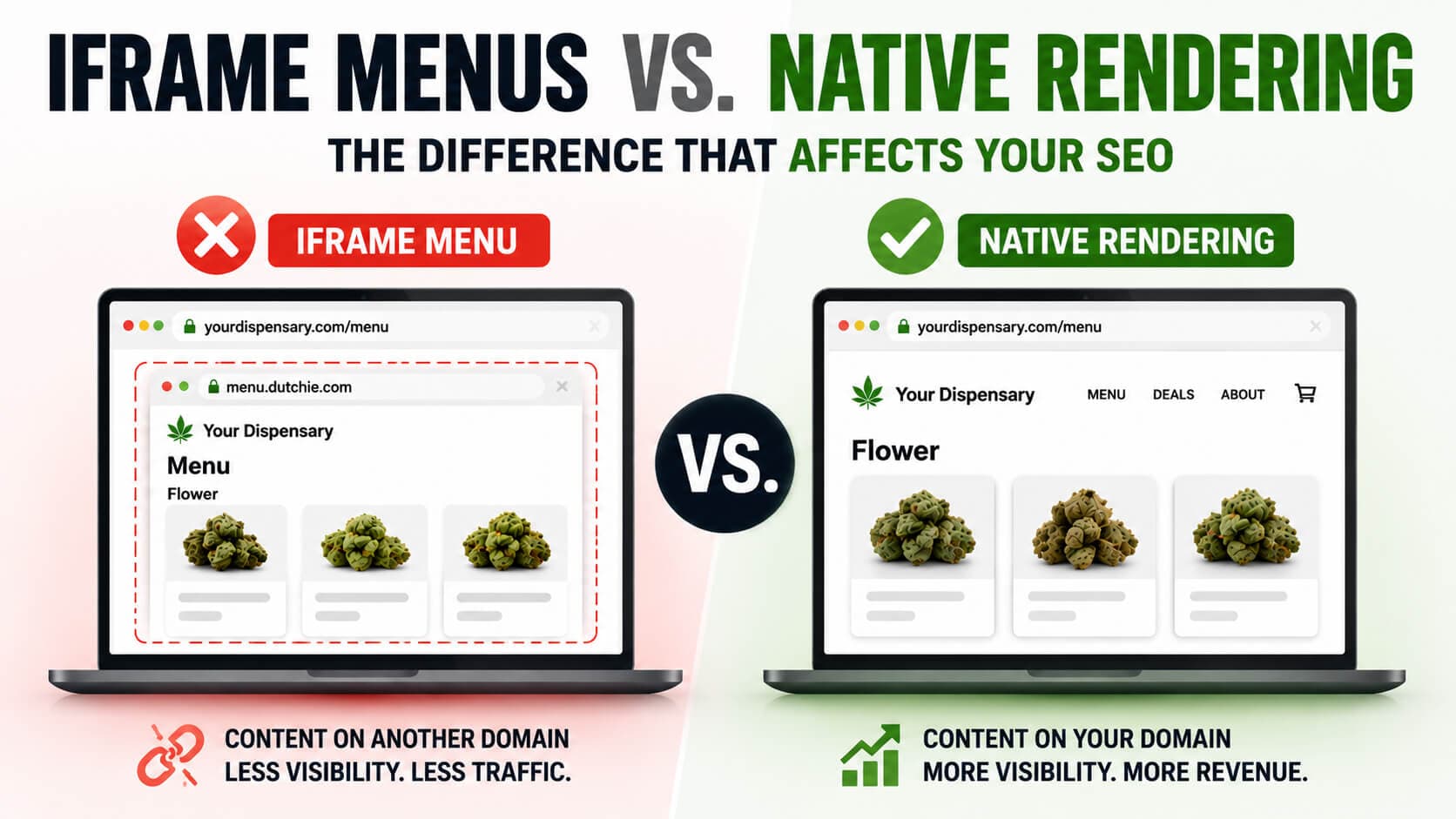
If your dispensary menu loads through an iframe or externally rendered ecommerce system, Google may not fully associate your products, category pages, and strain content with your dispensary's domain.
That can limit organic rankings for high-intent cannabis searches like product names, brands, and local inventory queries.
Platforms with native or properly optimized on-domain rendering, such as Dutchie Ecommerce Pro and Jane Boost, give dispensaries stronger SEO visibility because product content is rendered directly on the dispensary's own website.
Most dispensaries do not have an SEO problem.
They have an architecture problem.
We regularly audit dispensary websites that invest heavily in:
blog content
backlinks
technical SEO
Google Business Profile optimization
local landing pages
…yet their product pages barely rank in Google.
Why?
Because many cannabis ecommerce menus still rely on iframe or externally rendered infrastructure that limits how much SEO authority Google associates with the dispensary’s own domain.
The result is frustratingly common:
competitors rank for local product searches
category pages struggle to perform
organic traffic plateaus
branded searches dominate visibility
transactional cannabis keywords go elsewhere
And in many cases, the dispensary owner has no idea the problem exists.
This guide explains:
how iframe dispensary menus affect SEO
what Google actually sees when it crawls your website
why native rendering matters
which Dutchie and Jane products support stronger SEO
what kind of traffic upside dispensaries can realistically expect after migrating
What Is an iframe Menu?
An iframe is an HTML element that embeds one website inside another website.
A dispensary using an iframe menu may have code that looks something like this:
That code tells the browser:
"Load content from another website here."
To customers, the menu appears to be part of your dispensary website.
But technically, the content may be served from:
another third-party ecommerce domain
That distinction matters because Google evaluates websites primarily based on the domain where content is rendered and indexed.
If your products load externally, Google may not assign the full SEO value of those pages to your dispensary website.
How Google Sees iframe Menus
Google does not evaluate websites the same way customers see them visually.
Googlebot primarily analyzes:
rendered HTML
links
structured data
metadata
crawlable page content
On many iframe-based dispensary websites, Google may primarily see:
your header
navigation
footer
contact information
an embedded external frame
Meanwhile, the actual:
products
strain pages
category pages
product descriptions
brand collections
…may be rendered externally.
This can limit how strongly Google associates those products with your dispensary’s domain.
In practice, dispensaries using legacy iframe infrastructure often struggle to build organic visibility for:
local product searches
branded cannabis queries
category pages
long-tail inventory searches
How to Check if Your Menu Has SEO Limitations
You can usually diagnose this yourself in under a minute.
Step 1
Visit your dispensary's menu page.
Step 2
Right-click and select:
"View Page Source"
Do not select "Inspect."
Step 3
Search the source code for:
iframe
If you see references to:
another external menu domain
…your menu may have SEO limitations related to external rendering.
If your products render directly on your own domain instead, your setup is likely much more SEO-friendly.
Why iframe Menus Hurt Dispensary SEO
Cannabis SEO is heavily driven by product-level relevance.
Searches like:
"live resin gummies near me"
"buy Blue Dream Bakersfield"
"stiiizy pod dispensary"
"solventless rosin nearby"
…carry strong purchase intent.
These searches convert well because the customer already knows what they want.
However, if Google cannot strongly associate your product pages with your own domain, your dispensary may struggle to rank for many of these high-converting searches.
That impacts:
category rankings
product visibility
internal linking strength
topical authority
long-tail keyword growth
local inventory searches
We regularly audit dispensary websites where fewer than 5% of indexed URLs are product or category pages.
That is a major missed opportunity for organic growth.
The Revenue Impact of Native Rendering
One cannabis ecommerce migration case study documented:
+69.68% organic traffic
+104% conversion rate
+145% transactions
+74.3% revenue
…after transitioning from iframe-style rendering to a native ecommerce implementation.
These gains are significant because the dispensary was not simply "improving SEO."
It was finally allowing Google to properly crawl, index, and associate product pages with the dispensary's own domain.
For many dispensaries, switching to native rendering is less about SEO optimization and more about enabling SEO visibility in the first place.
Simple Revenue Estimate
You can estimate the potential upside fairly quickly.
Metric | Example |
|---|---|
Monthly online revenue | $300,000 |
Organic traffic share | 25% |
Organic-driven revenue | $75,000 |
Estimated traffic uplift | 40% |
Estimated monthly upside | $30,000 |
That equals:
$360,000 annually
before conversion rate improvements
iframe vs Native Rendering Comparison
Feature | iframe Menu | Native Rendering |
|---|---|---|
Product pages associated with your domain | Limited | Strong |
Product SEO authority | Weak | Strong |
Category ranking potential | Limited | Much stronger |
Product schema support | Limited | Strong |
Internal linking value | Reduced | Strong |
Long-tail keyword visibility | Limited | High |
Local inventory SEO | Weak | Strong |
Dutchie SEO Breakdown
Legacy Dutchie iframe Embeds
Many older Dutchie implementations relied on iframe-based rendering.
These setups often limited:
product indexation
metadata control
category authority
internal linking value
If your dispensary still uses a legacy embed setup, upgrading should be considered seriously.
Dutchie Ecommerce Standard
Dutchie Ecommerce Standard is a major improvement over legacy iframe implementations.
According to Dutchie's support documentation, Standard includes built-in SEO capabilities and improved indexability compared to older embedded menu systems.
For many dispensaries, Standard resolves the most serious SEO limitations associated with iframe menus.
Dutchie Ecommerce Pro
Dutchie Ecommerce Pro is Dutchie's most SEO-focused ecommerce offering.
Features include:
custom metadata
URL control
schema markup
canonical management
advanced analytics integrations
stronger on-domain rendering support
For dispensaries prioritizing long-term organic growth, Pro is typically the stronger SEO solution.
Important Note About Dutchie Plus
Some dispensaries use fully custom storefronts powered by Dutchie Plus APIs.
These setups can perform very well for SEO if implemented correctly.
However, Dutchie has announced plans to sunset Plus at the end of 2026, making migration planning increasingly important for dispensaries still using it.
Jane SEO Breakdown
Jane Web-Menu
Jane Web-Menu is easy to deploy and operationally convenient.
However, it still relies heavily on externally rendered content, which can limit SEO performance compared to fully native rendering systems.
Although the plugin has improved substantially over time with:
sitemap support
canonical handling
SEO plugin compatibility
…it still does not provide the same SEO advantages as native rendering.
Jane Premium
Jane Premium improves WordPress integration and can provide stronger routing and attribution support compared to traditional embedded implementations.
However, it still falls short of fully native rendering.
Jane Boost
Jane Boost is Jane's SEO-focused menu solution.
According to Jane's public product announcements, Boost improves:
crawlability
native rendering support
product visibility
deep linking
mobile usability
For dispensaries prioritizing organic search growth, Jane Boost is generally the minimum tier worth considering.
Jane Roots
Jane Roots is Jane’s headless API framework.
This gives agencies complete control over:
rendering
metadata
schema
URLs
page architecture
It is highly flexible but requires ongoing development resources.
What Happens After You Switch?
Dispensaries often expect immediate ranking improvements after migration.
Usually, the process is more gradual.
Weeks 1-2
Google discovers and crawls new product pages.
Submitting updated sitemaps through Google Search Console can accelerate discovery.
Weeks 2-6
New pages begin indexing.
Search Console coverage expands.
Months 1-3
Early rankings often appear for:
local product searches
specific brands
long-tail inventory queries
This is where many dispensaries see their first meaningful traffic increases.
Months 3-6
SEO authority compounds.
Internal linking becomes stronger.
Category pages often improve significantly.
Months 6-12
The long-term SEO impact becomes more visible, especially in competitive cannabis markets.
Common Dispensary Migration Mistakes
A poorly executed migration can still damage SEO performance.
Common mistakes include:
broken redirects
unnecessary URL changes
duplicate content
missing canonicals
metadata loss
incomplete sitemap handling
Cannabis ecommerce migrations have platform-specific complexities that many general agencies do not fully understand.
Working with developers experienced in cannabis ecommerce architecture can help avoid expensive SEO mistakes.
Frequently Asked Questions
Can Google index Dutchie menus?
It depends on the implementation.
Legacy Dutchie iframe embeds have significant SEO limitations.
Dutchie Ecommerce Standard and Dutchie Ecommerce Pro provide much stronger indexability and on-domain rendering support.
Is Jane Web-Menu bad for SEO?
Not necessarily.
However, native rendering systems like Jane Boost and Jane Roots generally provide stronger SEO performance.
What is native rendering?
Native rendering means product content is rendered directly on your dispensary’s own domain and HTML structure rather than loading externally from another domain.
Does this affect Google Ads?
Indirectly.
The iframe issue primarily impacts organic search visibility.
However, stronger landing pages can improve:
engagement
conversion rates
Quality Score signals
…which may support paid performance over time.
Can I fix iframe SEO problems without migrating?
Usually not completely.
You can improve:
metadata
local SEO
supporting content
backlinks
…but if product content is still rendered externally, the core SEO limitation often remains.
How long does migration take?
Most dispensary migrations take:
several weeks technically
several months for full SEO impact
The timeline depends on:
site size
URL structure
platform choice
implementation quality
The Bottom Line
If your dispensary menu still relies heavily on iframe or externally rendered architecture, your SEO growth may be artificially capped.
Your products may struggle to build authority on your own domain.
Your category pages may underperform.
And competitors with stronger native rendering infrastructure can steadily capture high-intent cannabis traffic in your market.
For many dispensaries, fixing menu architecture produces bigger SEO gains than:
publishing more blogs
buying backlinks
tweaking title tags
creating more strain pages
Because until Google can properly associate your inventory with your website, your ecommerce SEO foundation remains incomplete.
The good news is that the solution already exists.
Platforms like:
Dutchie Ecommerce Pro
Dutchie Ecommerce Standard
Jane Boost
Jane Roots
…give dispensaries significantly stronger control over:
crawlability
metadata
product indexation
category authority
organic growth
And once Google can properly access your product ecosystem, long-term SEO becomes much easier to scale.
Find Out If Google Can Actually See Your Products
We'll audit:
your menu architecture
indexed product pages
crawlability
rendering setup
platform limitations
organic visibility gaps
You'll receive:
a technical SEO assessment
indexation analysis
migration recommendations
estimated traffic upside
No obligation required.
Request Your Free Dispensary SEO Audit.