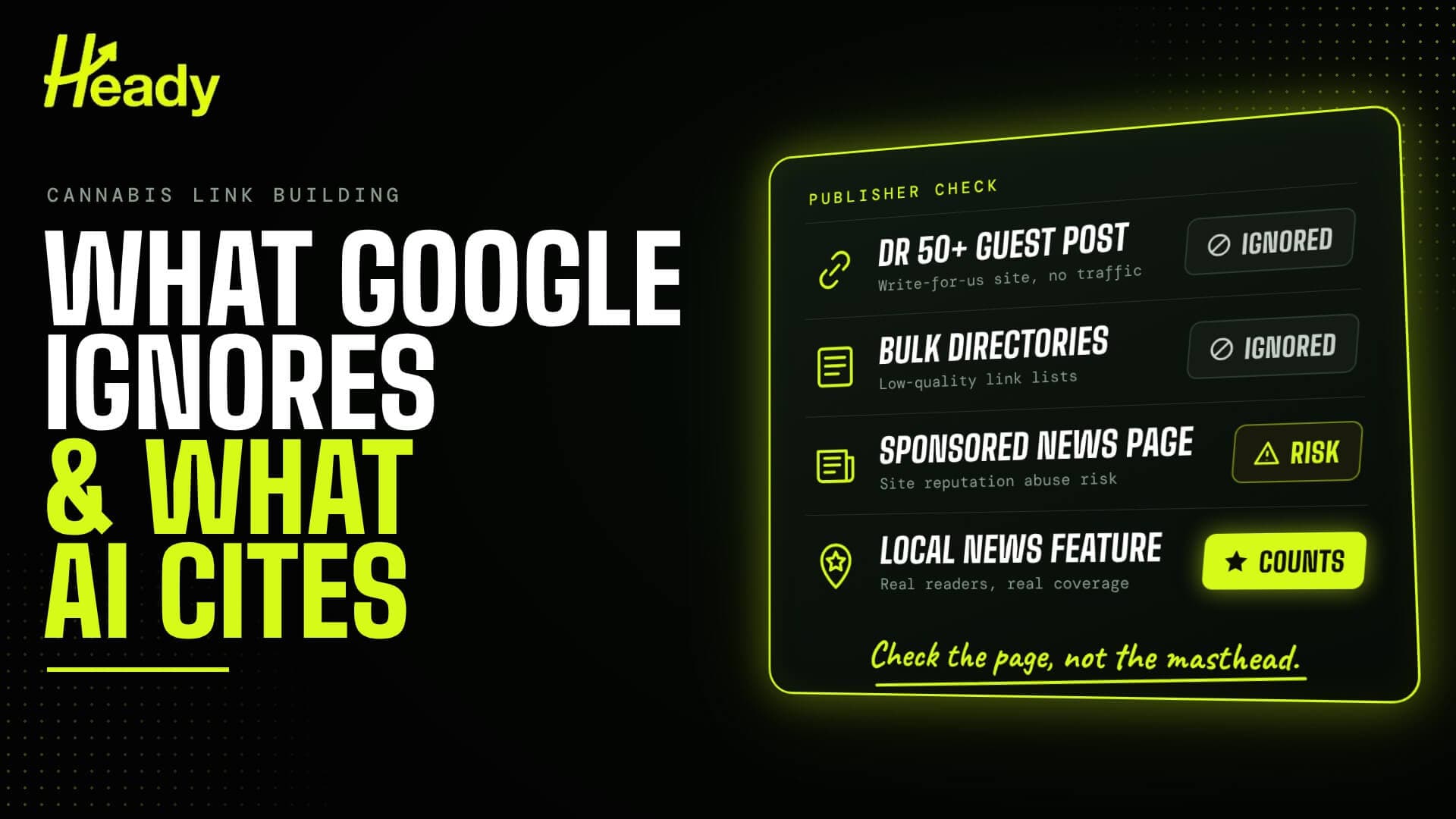
With Google Ads mostly closed to cannabis, organic search carries more of the load.
Then sooner or later someone offers you a package of "DR 50 cannabis guest posts." Most of those links are ones Google has already learned to ignore. What still works is a smaller number of placements on publications real people read, earned because you gave the editor a reason to cover you.
Here's how to tell the two apart before you pay, which shortcut carries the most risk, and how links and mentions shape what AI search says about you.
Why Cannabis Link Building Works Differently
Cannabis link building is the work of getting other websites to link to and mention your business, so search engines and AI systems treat you as a credible source. In most industries it sits next to paid search. In cannabis it often has to stand on its own. Google Ads doesn't allow ads for recreational drugs, and it only permits topical hemp CBD ads in California, Colorado and Puerto Rico.
That restriction shapes the whole market for cannabis placements. Demand for cannabis links is high, and the number of real publications willing to cover cannabis companies is small. The gap gets filled by sites that exist to sell links. They'll publish anything from any restricted niche, they show a respectable authority score, and they get very little search traffic of their own.
Most Cannabis Links for Sale Are Ones Google Already Ignores
Google's link spam policy reads like a catalog of what gets sold as cannabis link building. Paying for links that pass ranking credit is on the list. So are guest posts and press releases stuffed with keyword anchor text, low-quality directory links, and links made by automated services.
Google's enforcement is quieter than most people expect. Since its December 2022 link spam update, Google uses its SpamBrain system to neutralize unnatural links, and any credit those links passed is lost. There's no penalty notice and no dramatic drop, so you never find out you paid for links that do nothing.
What you're offered | What Google's policy says |
|---|---|
A "DR 50+ cannabis guest post" on a write-for-us site | Paid posts with links that pass ranking credit are link spam |
A press release with keyword anchors sent to hundreds of wire sites | Optimized anchor text in distributed press releases is link spam |
Bulk cannabis directory and bookmark submissions | Low-quality directory and bookmark links are link spam |
A sponsored article marked rel="sponsored" | Allowed. It passes no ranking credit, so judge it on readers and brand value |
The last row matters. Paying for exposure is normal. A sponsored feature in a publication your buyers read can be worth the money, as long as you're buying the audience and not pretending you bought rankings.
"Parasite" Placements Are the Riskiest Shortcut in Cannabis
Parasite placements are sponsored articles published on big, trusted domains, such as a newspaper or business site, so the article ranks on that domain's strength instead of your own. They look like the safe buy: high authority, a real brand name, sometimes a city in the masthead. At least one of the top-ranking cannabis link building guides recommends them.
Google calls this site reputation abuse. Its site reputation policy targets third-party content published on a host site mainly to borrow that site's ranking signals. And the example Google uses to explain when it's likely to take action involves CBD. It describes an unauthored article on a well-known business publication that links to a marketplace selling CBD oils. No editor is named, nothing is disclosed, and the article isn't linked from any of the publication's own sections.
That example is a near-perfect description of what many cannabis "news site" packages sell. The same policy says opinion pieces, columns, real editorial work and clearly disclosed advertorials written for the publication's readers are fine. So the test is the page, not the masthead. If the section has no named editor, doesn't connect to the rest of the site, and reads like an ad, treat it as risk, not authority.
Authority Scores Can't Tell You Whether a Link Counts
Domain Rating (DR) and Domain Authority (DA) estimate how many links point at a site. They don't tell you whether Google trusts that site or sends it any visitors. In cannabis those two things drift apart more than in most industries, because link sellers know buyers shop by DR, and many price their packages by DR tier.
A DR 60 site that ranks for nothing is a metric with a website attached. The score is evidence, not a verdict.
Not sure the links you've already paid for count? Get a cannabis PR and link building plan and we'll review your current links and the publishers behind them before recommending anything new.
A Five-Minute Check Before You Pay for a Placement
You don't need an agency to rule out most bad placements. Run these five checks on any publication before you py or pitch:
Look at its search traffic, not its score. Pull the site's organic traffic trend in Semrush or Ahrefs. Near-zero traffic, or a sharp drop that lines up with a Google spam update, is a sign Google stopped trusting it.
Check whether AI search cites it. Search a few questions in its niche and see if AI Overviews use it as a source. A site AI never cites is unlikely to help you get cited.
Read three recent articles. If casino reviews, payday loans and CBD gummies all ran the same week, the site sells links to anyone.
Ask who else is on it. Link vendors sell the same lists to many buyers. If your competitors already bought spots there, you're joining a footprint, not earning authority.
Check who it serves. A dispensary needs coverage from its own city or state. A brand needs outlets its buyers and retail partners read.
A placement that fails any one of these isn't worth much at any price. Our full publisher scorecard adds link placement, the publisher's outbound link profile and cost against the alternatives.
What Still Earns Cannabis Links
The links that still count share one trait: the publication had its own reason to run the story. Your job is to supply that reason. What it looks like depends on the kind of cannabis business you run.
If you are | Links that do the job | A story worth pitching |
|---|---|---|
A single dispensary | Local news, city business journals, local "best of" lists | A new opening, a hiring push, a community event that gets real coverage |
A multi-location operator or MSO | Market-by-market coverage, weakest locations first | Expansion into a new market, told differently in each city |
A brand or CPG company | Cannabis trade press, business and lifestyle outlets | Your own sell-through or market data, a launch, a founder with a real point of view |
Data is the most underused angle. Editors cite numbers they can't get anywhere else, and most dispensaries and brands already have sell-through, pricing or customer data in their POS or CRM that nobody has published. A clean dataset with one clear finding gives an editor a story, and the link comes with it. Our State of Cannabis reports are built in that format.
Local citations, meaning consistent name, address and phone listings across directories, matter too. They're a separate job that belongs in your cannabis SEO plan, not your link budget.
Links and Mentions Shape What AI Search Says About You
Backlinks help you rank. AI search adds a second payoff from the same work, but it's narrower than most vendors claim. An Omniscient Digital analysis of more than 23,000 AI citations looked at what AI tools cite when people ask about a brand by name. Earned media made up 48% of the sources, and the brand's own site made up 23%.
Note the condition: that's for branded questions, like "is [your dispensary] any good." It means coverage on other sites shapes much of how AI describes you once someone already knows your name. It doesn't prove that links get you recommended for "best dispensary near me." Those answers draw on reviews, local listings and lists as well.
Two practical points follow. A mention without a link still counts as coverage AI can read, so don't turn down a good feature because the link is missing or nofollow. And nobody can sell you a guaranteed spot in an AI answer. If AI visibility is your goal, read why dispensaries go missing from AI search before you buy anything.
What a Fair Link Building Offer Looks Like
Price depends on the publication mix, the number of markets, and whether placements are earned, contributed or sponsored. A flat price per link tells you more about the seller than the work.
A fair offer names:
the actual publications before you pay, not a DR range
the job each placement does, such as ranking one page, building coverage in one market, or backing up your brand story
how many of your competitors are already on each site
whether a link is likely and what attribute it will carry, since the publisher controls both
how results get verified, with the live URL and whether it's indexed
Guaranteed dofollow links and a large fixed number of links every month are the red flags. They describe inventory, not a campaign.
When Links Aren't the Bottleneck
Links aren't always what's holding a dispensary back. If your Google Business Profile (GBP) is thin, your reviews are stale, or your location pages say nothing a competitor's don't, new placements push on pages that can't win anyway. Fix those first. Then compare your coverage with the stores beating you in the map pack. Share of Map shows where you stand against them.
Start With the Gap, Not the Package
If you're weighing a link package right now, run the five-minute check on three of the sites in it, and if they fail, keep your money. If you want a second opinion on your current links and where authority is really costing you, get a PR and link building plan from Heady. If links aren't the problem, we'll say so.
FAQ
Do Nofollow Links Help Cannabis SEO?
Sometimes. Since 2019, Google has treated nofollow, sponsored and ugc as hints for ranking rather than hard rules. A nofollow link from a strong local outlet may still count, and it still sends readers and puts your name on a trusted page. Don't pay a ranking-link premium for it, but don't turn down good coverage because the link is nofollow.
Should a Dispensary Disavow Old Spammy Links?
Usually not. Google says to disavow links only when you have a considerable number of spammy or artificial links and they have caused, or likely will cause, a manual action. If a past vendor built junk links and Search Console shows no manual action, Google is most likely ignoring them already. Spend the time earning better ones.
How Many Backlinks Does a Dispensary Need?
There's no fixed number. Look at the referring domains of the two or three stores that outrank you in your market, then check where their links come from. If they have local news coverage and you have none, that's the gap to close. If your link profiles look about the same, the gap is more likely on your site or your GBP.