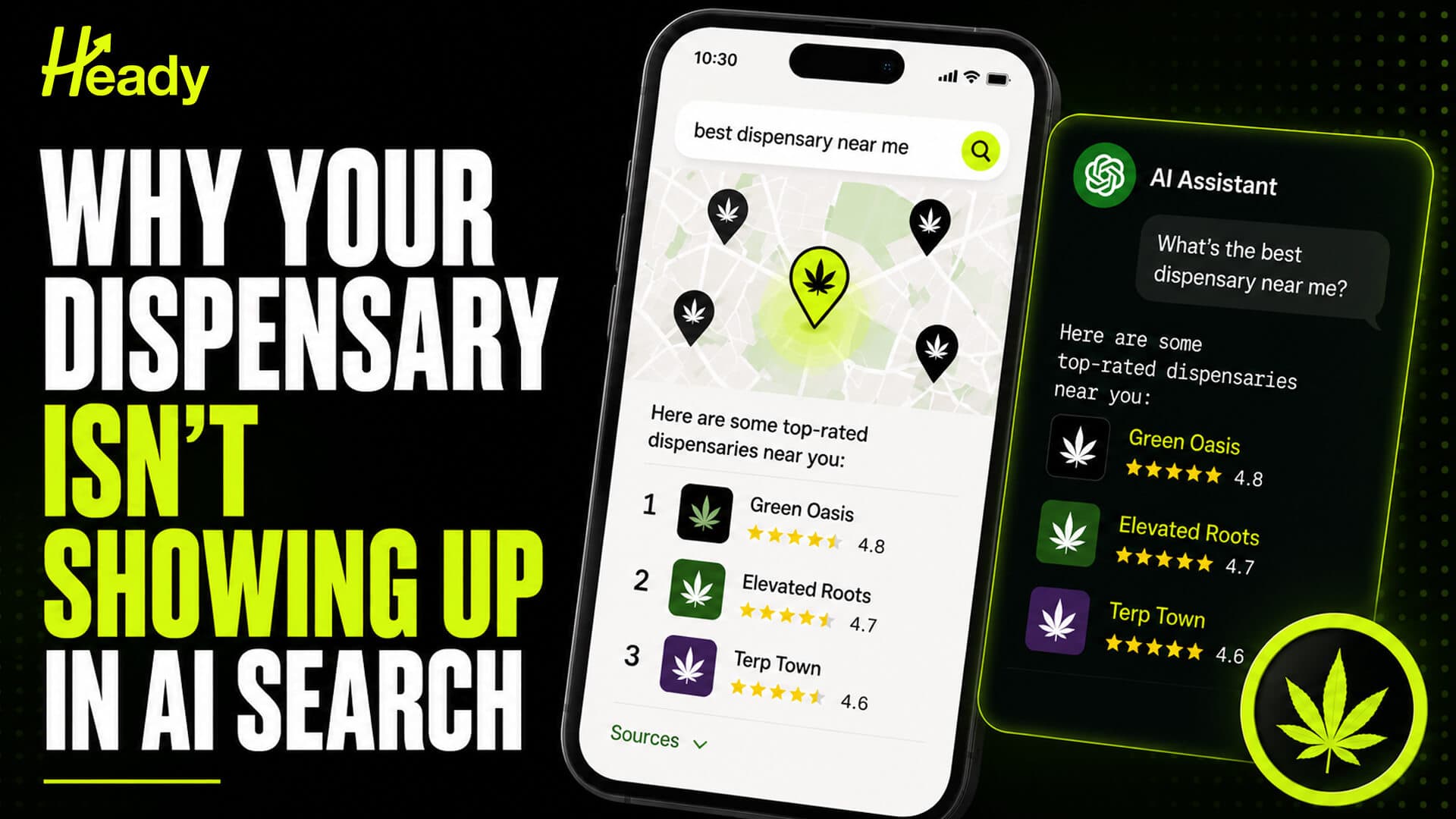
Your dispensary probably isn't showing up in AI search because AI assistants can't confidently understand, verify, or extract the facts they need to recommend you.
That is the plain answer.
A customer asks ChatGPT, Perplexity, Gemini, or Google, "What's the best dispensary near me?" or "Where can I buy live rosin in Denver?" The answer names three stores. Yours is not one of them.
Most dispensary operators assume this is an SEO problem. Sometimes it is. But showing up in AI search is not the same as ranking on Google.
Google still matters. Your website still matters. Your Google Business Profile still matters. But AI answers work differently. They do not just list pages. They synthesize an answer, decide which businesses are safe to name, and often cite the sources that support that answer.
That means your dispensary does not just need to be findable. It needs to be understandable, verifiable, fresh, and easy to quote.
AI search is not the same as Google search
AI search does not behave like a normal search results page.
A classic Google result gives users a list of links. An AI answer tries to give them the answer directly. That sounds like a small interface change. It is not.
For dispensaries, the difference is huge.
In classic cannabis SEO, the goal is often to rank a page for searches like "dispensary in [city]" or "weed deals near me." In AI search, the goal is different: get your store named inside the answer when the assistant recommends where someone should go.
Google's guidance says its generative AI features, including AI Overviews and AI Mode, are rooted in its core Search ranking and quality systems. Google also says SEO best practices still apply to generative AI search, but that eligibility does not guarantee inclusion.
So no, SEO is not dead. But "we do SEO" is not a complete answer either.
Ranking well in classic search can help. It does not guarantee that ChatGPT, Perplexity, Gemini, or Google's AI results will name your dispensary when a shopper asks for a recommendation.
OpenAI describes ChatGPT search as a way to get timely answers with links to relevant web sources. Perplexity describes its search products as using real-time, ranked web results from a refreshed index. Google says AI features in Search can include links and source material so users can explore related content.
That is the shift.
You are no longer only competing for a position. You are competing to be selected as a reliable answer.
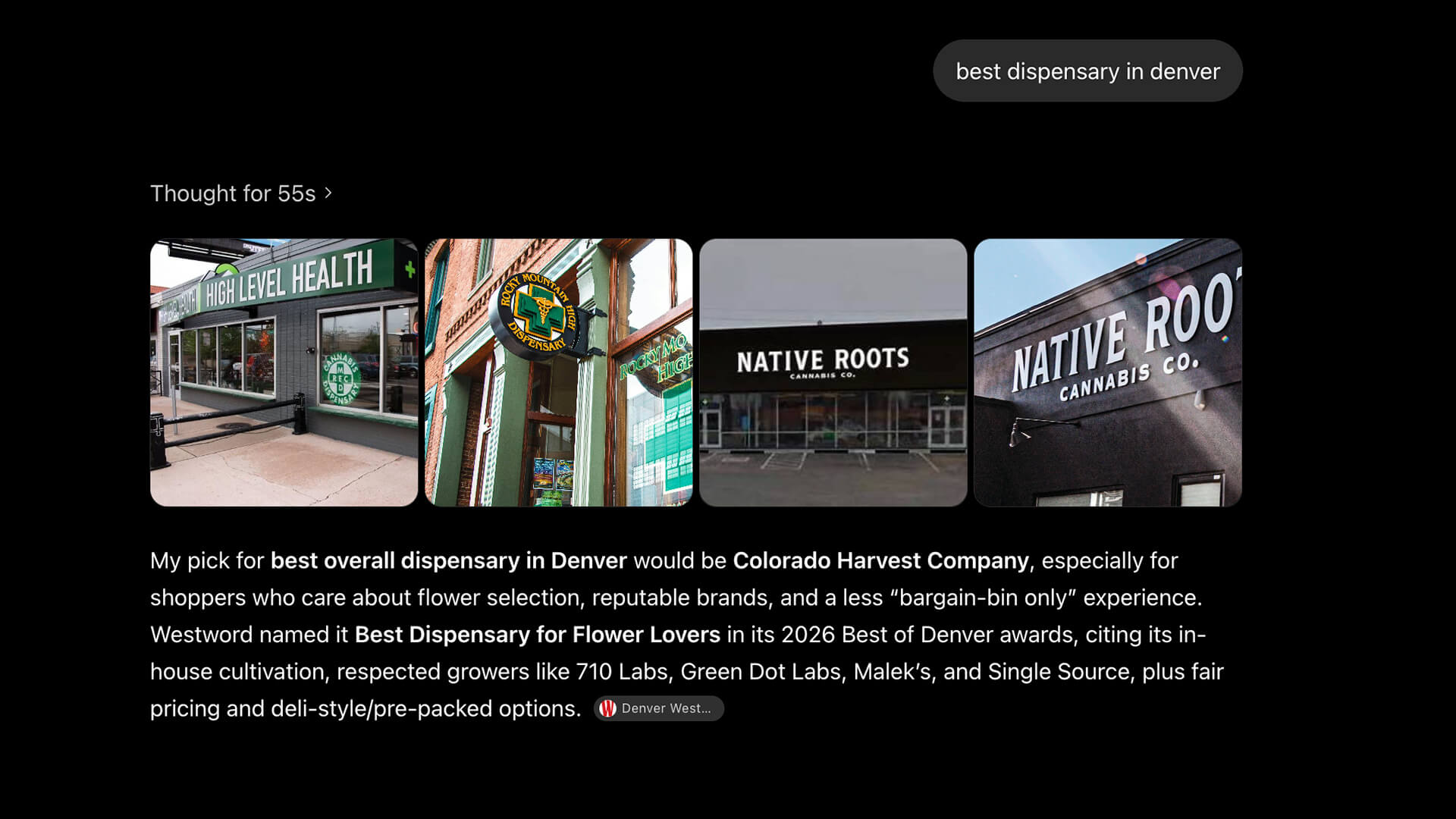
How AI decides which dispensaries to name
AI assistants do not "like" one dispensary more than another. They assemble confidence.
That confidence usually comes from five signals.
1. Entity clarity
The system needs to understand that your dispensary is a real, distinct business.
That sounds basic until you look at how messy local cannabis data gets. Store names change. Locations move. Menus live on third-party platforms. One citation says "Dispensary," another says "Cannabis Co.," and your website uses a different brand name in the footer.
AI systems are trying to answer questions like:
Is this a real store?
Where is it located?
Is it open?
Is it medical, recreational, delivery, pickup, or all of the above?
Is this location different from the brand’s other locations?
If your own digital footprint gives mixed answers, AI has less reason to name you.
2. Third-party corroboration
Your website can say you are the best dispensary in town. That does not make it true.
AI search leans on agreement across sources. Your website, Google Business Profile, review platforms, local directories, menus, articles, social profiles, and reputable mentions all help build or weaken confidence.
This is where many dispensaries lose. They have a decent website, but nothing else online backs up the claims that matter.
If customers ask, "best dispensary for concentrates in [city]," the assistant needs evidence. A location page with "best concentrates" stuffed into a paragraph is weak. Product categories, reviews, menu data, expert content, local mentions, and consistent business listings are stronger.
3. Extractable content
AI can only use what it can access and understand.
If your hours, deals, menu, product categories, pickup options, and location details are buried in scripts, images, tabs, or third-party iframes, the answer engine may not be able to cleanly extract them.
This is the cannabis menu problem in plain English.
Many dispensary menus are embedded through platforms like Dutchie or Jane. Those tools can be useful for ecommerce operations. But if your product and category data are trapped in an iframe, your website may not own much crawlable menu content.
To a customer, the menu looks fine.
To a search system, your site may look thin.
4. Freshness and consistency
Dispensary recommendations are time-sensitive. Hours change. Deals expire. Inventory changes daily. Locations add pickup options, delivery zones, loyalty programs, or new categories.
If your site says one thing, your Google Business Profile says another, and your menu platform says a third, AI has to decide which version to trust.
For AI search, freshness is not a vanity signal. It is risk control.
5. User fit
AI answers are contextual.
A shopper asking "best dispensary near me" may get a different answer than someone asking "where can I buy solventless rosin near downtown?" or "what dispensary has the best first-time customer deal?"
That means broad visibility is not enough.
Your site needs clear pages and content for the questions customers actually ask:
Where are you located?
What do you sell?
Who are you best for?
What makes your store different?
What deals or shopping options are available?
Why should someone choose you over the other stores nearby?
If your site only says "premium cannabis products" and "knowledgeable budtenders," you are giving AI the same beige language as everyone else.
Why your dispensary is invisible in AI search
If your dispensary is missing from ChatGPT, Perplexity, Gemini, or AI Overviews, one or more of these issues is usually the reason.
Problem | Why it matters | What to fix |
|---|---|---|
Your menu is trapped in an iframe | AI may not connect your products and categories to your website | Build crawlable menu, category, and product content |
Your location data is inconsistent | AI cannot confidently match your store across sources | Standardize name, address, phone, hours, and URLs |
You lack LocalBusiness schema | Search systems have less structured context about your store | Add accurate LocalBusiness markup |
Your content is too thin | AI has no useful answer to quote or cite | Create clear pages for products, deals, locations, FAQs, and shopping intent |
Your claims are unsupported | "Best dispensary" means little without corroboration | Earn trusted mentions, reviews, citations, and local proof |
Your Google Business Profile is incomplete | Local AI answers may rely on business data and local signals | Keep categories, hours, photos, services, and links current |
You optimized for keywords, not answers | Ranking language is not always recommendation language | Write pages that directly answer customer questions |
Your site is hard to crawl | AI-connected search systems still need accessible web content | Fix indexing, JavaScript, page speed, internal links, and blocked resources |
Your content is stale | AI avoids risky recommendations when details may be outdated | Refresh deals, hours, menus, events, and location pages |
You have no clear category authority | AI cannot tell what you should be recommended for | Build depth around flower, vapes, edibles, concentrates, medical, delivery, or other strengths |
Do not treat this as a gimmick checklist.
This is the work behind AI visibility. The dispensary that gives answer engines clear, consistent, corroborated information has a better shot at being named than the store with a prettier site and no extractable substance.
Google's guidance is clear that generative AI visibility does not require a special "AI SEO" file, new magic markup, or inauthentic mentions. It points site owners back to technical accessibility, useful content, and search fundamentals.
That is good news. It means the fix is not mysterious.
It is just more demanding than the old playbook.
What fixing AI search visibility actually looks like
Fixing AI visibility is not one plugin, one schema snippet, or one "AI SEO" hack.
It is a visibility system.
At Heady, this work fits inside modern cannabis SEO services because the foundation is still search: technical structure, local visibility, schema, useful content, site architecture, and the way your deals, products, and location pages are displayed.
The difference is that AI search raises the bar. Your site cannot simply exist. It has to explain your business clearly enough for people, crawlers, and answer engines to trust it.
Clean up the entity
Start with the business itself.
Make sure your dispensary's name, address, phone number, website, location URL, hours, categories, and social profiles match across the web. If you have multiple locations, each location needs its own clean identity.
A brand page is not enough. A location page should tell both people and machines exactly what that store is, where it is, what it offers, and how it differs from nearby options.
Make the site easier to extract
Your website should answer customer questions in plain, crawlable content wherever possible.
That includes hours, address, parking notes, pickup options, delivery zones, product categories, brand availability, deals, loyalty information, and shopping FAQs.
Google's guidance for generative AI search says crawlable content, technical requirements, page experience, and helpful content still matter.
The practical takeaway: do not hide your most valuable business information inside tools AI may struggle to parse.
Add structured data without overpromising
LocalBusiness schema can help search engines understand your business details. Organization schema can help disambiguate the broader brand. FAQ schema can support clearly structured answers where appropriate.
But schema is a label, not a substitute.
If your page does not visibly say what your schema says, you are not building trust. You are creating risk.
Use schema to clarify real content. Do not use it to compensate for missing content.
Build corroboration outside your website
AI recommendations often depend on more than your own pages.
You need third-party proof. That can include relevant local mentions, cannabis directories, review platforms, event pages, brand partner pages, news coverage, community sponsorships, and high-quality industry resources.
The goal is not fake buzz.
The goal is agreement. When multiple trusted sources describe your dispensary the same way, AI has more reason to believe the pattern.
Relevant news coverage and third party editorial mentions are one way to strengthen that external corroboration, which is why digital PR becomes part of an AI search visibility strategy.
Write for the questions customers ask AI
This is where most dispensary content misses.
Customers do not ask AI, "Which vertically integrated cannabis retail experience offers premium products?"
They ask:
What dispensary has the best deals near me?
Where can I buy Wyld gummies in [city]?
Who has the best rosin selection downtown?
Which dispensary is closest to Red Rocks?
What recreational dispensary is open late near me?
Where should I go if I’m new to cannabis?
Your site should answer those questions directly, honestly, and locally.
Not every answer needs a full blog post. Some belong on location pages, menu category pages, deal pages, FAQs, or guides. The point is to create content that helps shoppers make a decision.
That is also the content AI can cite.
How to check if your dispensary is invisible right now
You can run a simple AI visibility check in five minutes.
Open ChatGPT, Perplexity, Gemini, and Google. Then ask the questions your customers would ask:
"What is the best dispensary in [city]?"
"What dispensary has the best weed deals in [city]?"
"Where can I buy [product type] near [neighborhood]?"
"What dispensary near me is good for first-time cannabis shoppers?"
"Which dispensary in [city] has the best concentrates?"
Do not only test your brand name. That is the easy version.
The money is in unbranded recommendations. If AI only finds you when someone asks for you by name, you are not winning discovery. You are just findable after the customer already knows you exist.
Track what happens:
Who gets named?
Which sources get cited?
Does your store appear at all?
Are the details accurate?
Does the answer mention outdated hours, wrong locations, or missing services?
Does the assistant recommend competitors for categories you actually carry?
This is where the problem gets real fast.
A dispensary operator can ignore "AI search" as a trend. It is much harder to ignore an answer that recommends three competitors to a ready-to-buy shopper.
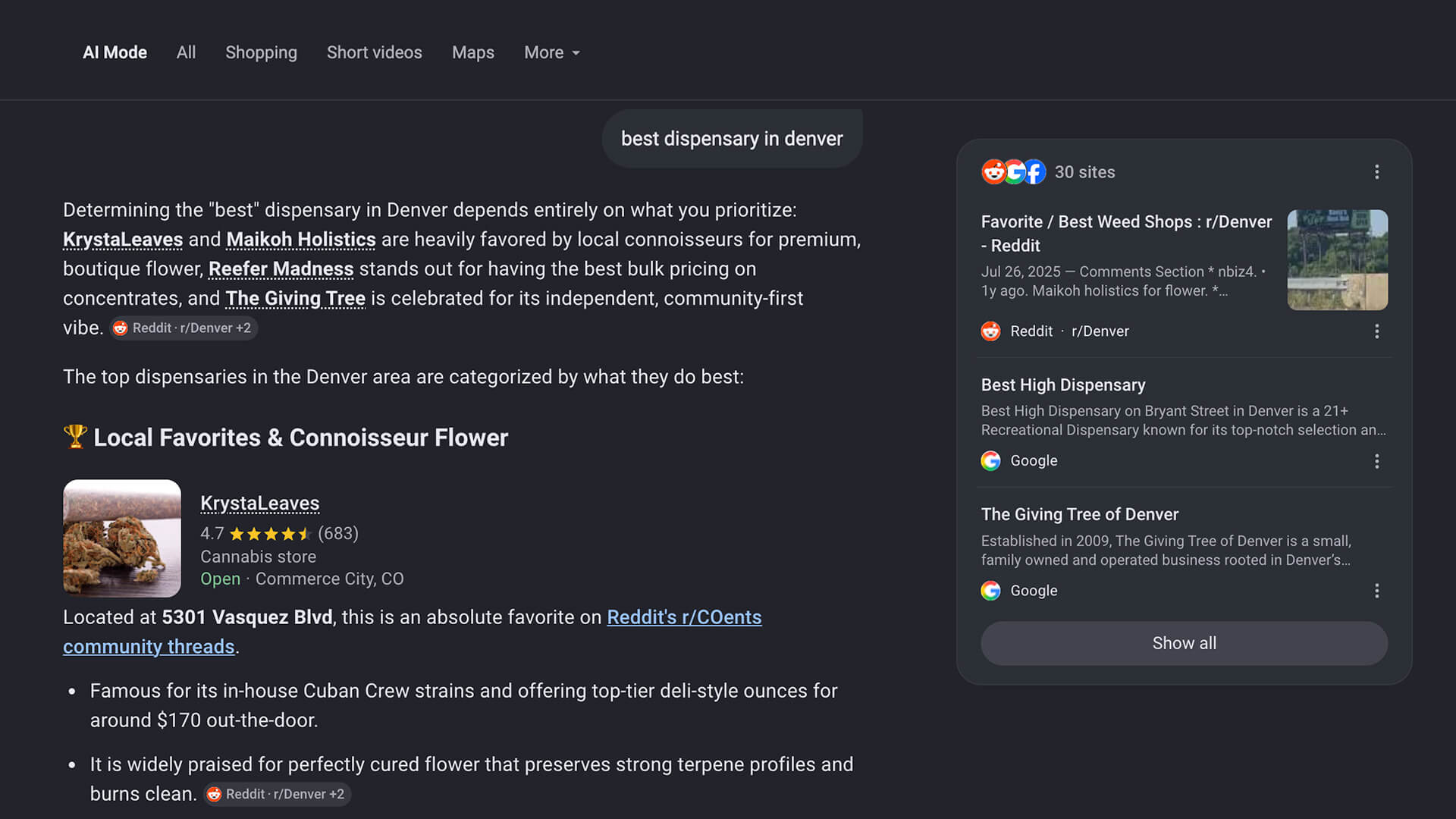
If your store is missing from those answers, treat it as a cannabis SEO visibility issue. The fix starts with making your dispensary clearer, more crawlable, more consistent, and more trustworthy across the web.
Why this is still early
AI search visibility is not mature yet. That is the opportunity.
Most dispensaries are still focused on classic rankings, paid listings where allowed, social content that may or may not survive platform rules, and menu platform optimization. Those channels matter. But they do not fully cover how shoppers are starting to ask for recommendations.
Google introduced guidance for site owners around AI Overviews and AI Mode because generative AI is now part of how Search presents information. That is a strong signal that AI visibility is becoming something site owners will need to measure, not just debate.
The cannabis category is even earlier.
Most operators have not audited whether AI assistants recommend them. Most agencies are still recycling generic SEO advice with "AI" stapled to the front. And most local competitors have the same weaknesses: messy entity signals, thin content, iframe menus, inconsistent listings, and little third-party corroboration.
That window will not stay open forever.
The first dispensaries to make their businesses easier for AI to understand, verify, and cite will have an advantage before everyone else starts asking why they are invisible.
FAQ
Why isn’t my dispensary showing up in ChatGPT?
Your dispensary may not show up in ChatGPT because the assistant cannot confidently verify your location, menu, reviews, business details, or category authority from accessible web sources. The fix is not just "better SEO." You need clearer entity signals, extractable content, consistent listings, and third-party corroboration.
Is AI search different from SEO?
Yes. SEO still matters, especially crawlability, content quality, local signals, and technical structure. But AI search adds another layer: your business has to be selected inside a synthesized answer. That means your dispensary must be easy to understand, verify, and cite.
How do dispensaries show up in AI Overviews?
Dispensaries can improve their chances of appearing in AI Overviews by following strong SEO fundamentals, keeping local business data accurate, publishing helpful and specific content, using appropriate structured data, and making key information crawlable. Google says its generative AI features use Search systems and that SEO fundamentals still apply.
Can I check if AI recommends my dispensary?
Yes. Ask ChatGPT, Perplexity, Gemini, and Google the same questions a shopper would ask, such as "best dispensary in [city]" or "where can I buy [product] near me." Then record whether your dispensary appears, which competitors are named, and which sources are cited.
Does ranking on Google mean I’ll show up in AI search?
No. Ranking well on Google can help, but it does not guarantee that your dispensary will be named in AI answers. AI systems often synthesize information from multiple sources, and they may choose businesses with clearer, fresher, or more corroborated signals.
AI search visibility is part of modern cannabis SEO
If your dispensary is not showing up in AI search, it does not mean your brand is weak. It means your digital footprint is not giving answer engines enough confidence.
That can be fixed.
Clean up the entity. Make your content extractable. Strengthen your local proof. Add accurate structured data. Build pages that answer real shopper questions. Free important menu and product signals from systems that hide them.
AI search is a different game, but it is not magic. It is becoming part of the same discovery path cannabis shoppers already use: search, maps, menus, reviews, and now AI-generated recommendations.
Your website cannot just target keywords anymore. It has to help search engines and AI assistants understand what your dispensary is, where you operate, what you sell, and why you deserve to be recommended.
If you want to see where your dispensary is missing from modern search and what it would take to fix it, contact Heady. We'll help you sort the real visibility gaps from the AI noise.