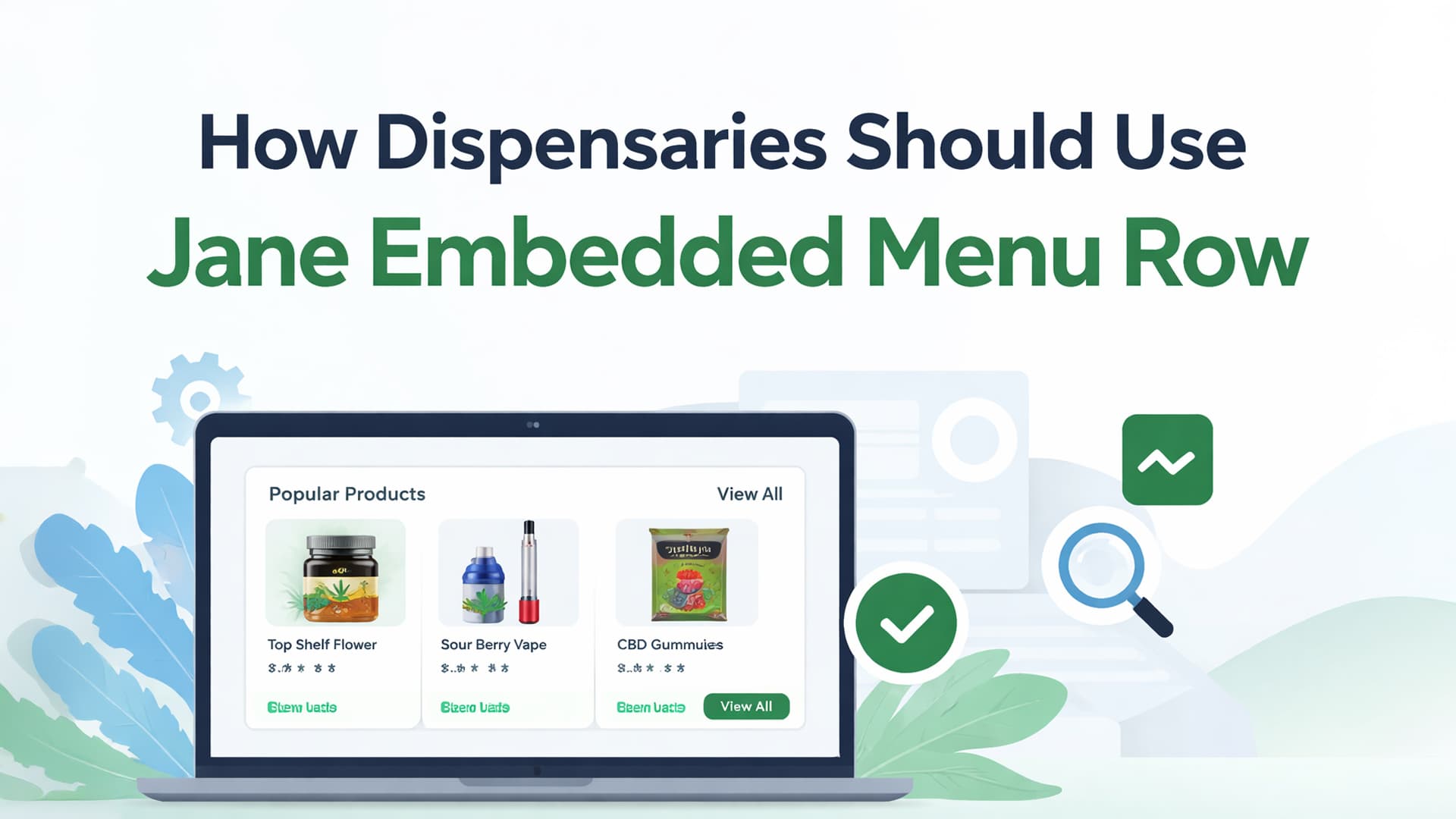
Jane Embedded Menu Row is a Jane Premium feature that lets dispensaries place a live, store-specific product row on a webpage. Its biggest value is not SEO by itself. Its biggest value is helping high-intent pages convert better by surfacing relevant, in-stock products closer to the moment a shopper is ready to act. It works best on location pages, deals pages, brand pages, and category pages. SEO, GEO, and UX benefits can follow when the page around the row is structured well.
Jane Embedded Menu Row can be a smart addition to a dispensary website, but only when it is used for the right reason.
The best way to think about it is not as an SEO feature or a design extra.
It is a practical way to make important pages more useful by bringing live inventory closer to the moment a shopper is ready to act, especially on pages where the visitor already has strong intent and just needs a faster path into shopping.
This article explains what Jane Embedded Menu Row does, where it works best, how it can improve conversion and customer experience, and where SEO fits into the picture without overstating it.
What Jane Embedded Menu Row Actually Does
Jane Embedded Menu Row lets a dispensary place a live Jane product row on a page on its own website.
According to Jane's setup documentation, the row is created from an enabled row in the Jane Business Dashboard. Jane provides two code snippets: a rendering script and embedded row HTML. Jane also says only one rendering script is needed per page, even if multiple embedded rows run on that page. The feature inherits site styles by default, uses a transparent background, is store-location specific, only shows in-stock products, opens product clicks in a new window, and sends "View all" clicks to the row's menu page.
In practice, that makes the feature best suited for pages that already have context, such as store, deal, brand, and category pages.
That also tells you what the feature really is.
It is not a full menu replacement. It is not a content strategy. It is not a shortcut to ranking. It is a live product-discovery module that helps connect a page with real inventory.
Used well, it helps bridge the gap between content and commerce.
Where It Works Best
Jane Embedded Menu Row lets a dispensary place a live Jane product row on a page on its own website.
This feature works best on pages where the shopper already has a reason to be there and would benefit from seeing products without taking extra steps.
Location pages: These pages already attract visitors who are checking a store, comparing options, confirming hours, or thinking about pickup. A live row can help turn that interest into action.
Deals pages: These pages often attract shoppers who are ready to buy, but many dispensary sites still make them dig through the menu to find qualifying items. A relevant row can shorten that path.
Brand pages: The page can explain what the brand is known for, while the row helps the shopper move from interest to browsing real products.
Category pages: These work well when the page gives the shopper a little context before presenting inventory.
Homepage sections: One row can work as a discovery module for repeat visitors or shoppers who already know what they want. It is less effective when it starts to crowd the page.
These page recommendations are strategic interpretation, not Jane product claims. They follow logically from how the feature behaves: live products, local inventory, click-through into the menu flow, and support for rows inside broader page content.
Why It Can Improve Conversion and UX
This is the real story.
Most dispensary websites lose momentum between the point where a visitor becomes interested and the point where that person reaches a useful product path. Jane Embedded Menu Row can help close that gap. Instead of making the shopper start from scratch in the menu, it brings live inventory closer to the page they are already using.
That can improve conversion in practical ways:
It reduces extra clicks
It makes key pages more actionable
It helps answer a shopper’s immediate question: what can I buy here right now?
It gives the page a stronger next step without forcing a full navigation reset
The UX value comes from relevance and timing. A row on the right page makes the site feel clearer and easier to shop. That matters in cannabis ecommerce, where shoppers often want quick confirmation that a store has the kinds of products they want before spending more time exploring.
Jane's broader MyHigh recommendation framework shows how Jane approaches merchandising and product discovery more broadly. Jane says MyHigh uses product descriptions and attributes, category and subcategory information, brand and lineage data, purchase history, browsing behavior, and current session signals.
For new or unrecognized shoppers, Jane says it combines local trends and aggregate shopper data with real-time session cues. Jane also says Personalized Recommended Rows can display up to three AI-curated rows, with the number of rows changing based on how much it knows about the shopper.
Those features are not the same thing as Embedded Menu Row, but they reinforce the larger strategic lesson: do not just show products, show the right products in the right context.
How Dispensaries Should Use It
Start with page purpose, not feature placement.
On a location page, the essentials should come first:
Store name
Address
Hours
Service options
Main actions
The row should support the page, not replace the page's main job.
On a deals page, explain the offer first, then use the row to make the deal easier to shop.
On a brand or category page, add a short intro so the visitor understands what they are looking at and why it matters. Then let the row help with discovery.
A few practical rules go a long way:
Use one row first before adding more
Give it a real heading tied to intent
Add one short sentence of context above it
Make the next action clear
Test the experience on mobile
This feature works best when it shortens the path to shopping without cluttering the page.
Where SEO and AI Search Fit In
SEO matters here, but it should not be the lead angle.
An embedded row can make a page more useful. That is good for users, and it can support a better page experience overall. But the page still needs enough content and structure to explain itself. Search engines and AI-driven systems need context, headings, page purpose, and supporting copy to understand why the page exists and what it is trying to help the visitor do.
Helpful content should be:
Clear
Substantial
Easy to scan
Intent-matched
Useful enough to satisfy the reader
So yes, the row can support a stronger page. It can also contribute to a better experience when it is framed well. But it does not replace the need for clear copy, useful headings, internal links, local relevance, and a page structure that actually answers the visitor’s need.
The row supports the page, but the surrounding copy and structure still do the interpretive work.
That is why the best SEO move is not to drop a row onto a thin page. The better move is to build a page with real value, then use the row to make that page more actionable.
From an LLM perspective, the same logic applies. AI systems can summarize a page more effectively when the module is explained clearly. A heading like "Popular Right Now at Our Boulder Dispensary" tells both users and AI systems more than a vague label like "Featured Products".
The surrounding copy does the interpretive work. The embedded row supports it.
Common Mistakes to Avoid
The first mistake is treating the feature like a ranking tactic. It is not.
The second is placing the row too high on the page. Shoppers should not have to scroll past products to find key store details or page context.
The third is using too many rows. More modules do not automatically create more value. In many cases, they create more clutter.
Other common issues include:
Weak section headings
No context around the row
Poor visual hierarchy
Inadequate mobile QA
Contrast or readability problems
A row that looks fine in theory can feel awkward on a real page if spacing, contrast, or hierarchy are off. This is especially important on mobile.
FAQ
What is Jane Embedded Menu Row?
It is a Jane Premium feature that lets dispensaries place a live Jane product row on a page on their website using embed code. The row is tied to a specific store and displays live, in-stock products.
What pages should dispensaries use it on?
The strongest fits are usually location pages, deals pages, brand pages, and category pages. Those are the pages where shopper intent is already strong and a live row can reduce friction most effectively.
Is Jane Embedded Menu Row good for SEO?
It can support a stronger page experience and make a page more useful, but it is not a standalone SEO strategy. The page still needs strong content, structure, and local relevance.
Can you use more than one embedded row on a page?
Yes. Jane says multiple embedded rows can run on a single page, and only one rendering script is needed per page. Most dispensaries will still get better results by starting with one well-placed row instead of stacking several.
How is it different from Jane’s recommended rows?
An embedded row is the on-page module placed on your site. Jane's MyHigh recommendation features are part of its broader merchandising approach. They are related conceptually, but they are not the same feature.
Get More from Jane on Your Website
Jane Embedded Menu Row works best when dispensaries use it to make high-intent pages more actionable. The feature is easy to add. The real value comes from placing it on the right pages, framing it with the right content, and tying it into a broader Jane strategy.
Need help with Jane Embedded Menu Row, Jane Premium, or Boost integrations? Contact us here.
Heady helps dispensaries plan, implement, and optimize Jane-powered website experiences that are clearer, more useful, and more likely to convert.