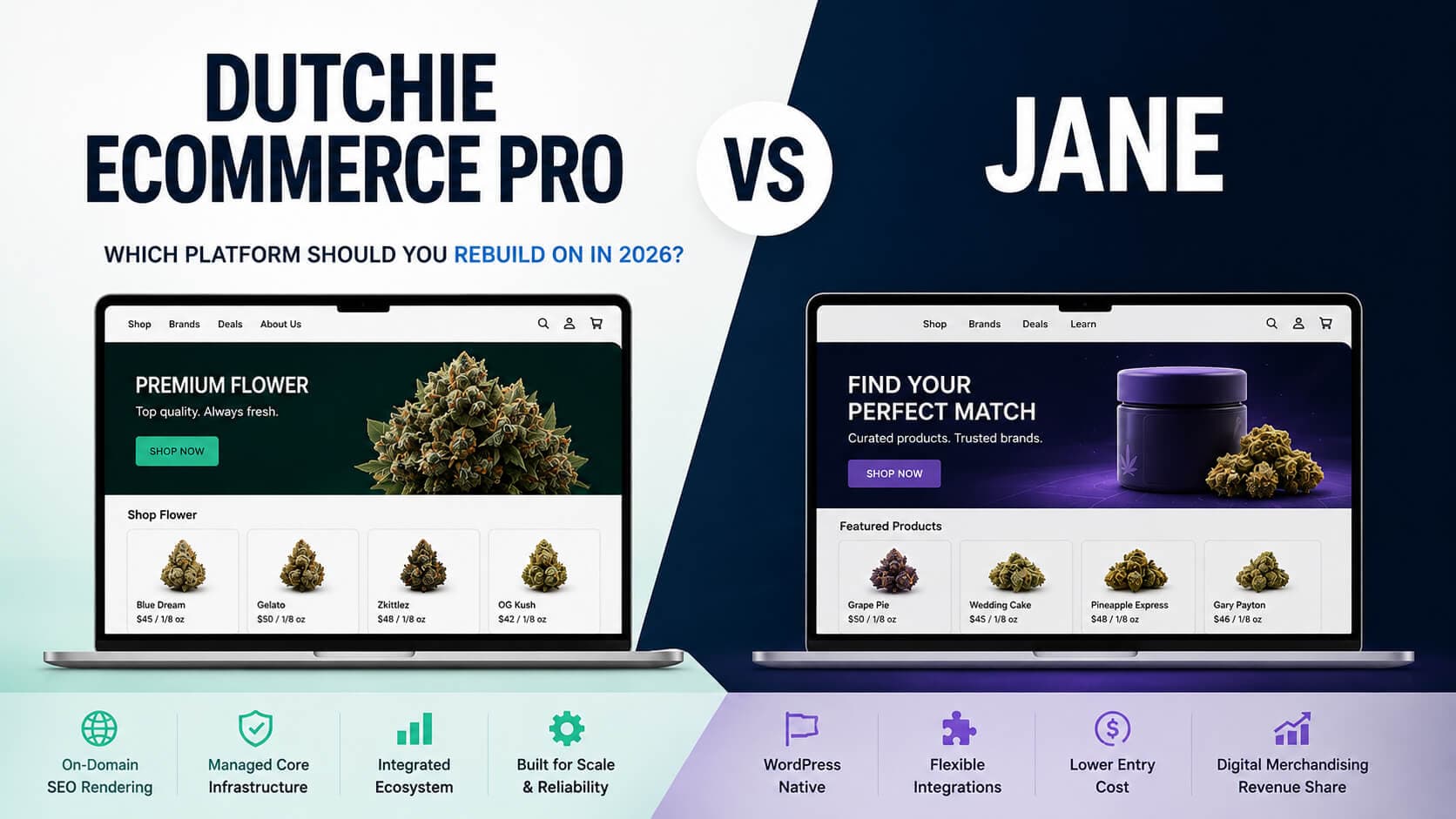
The end of Dutchie Plus support in December 2026 has forced dispensaries into a decision many operators have delayed for years: rebuild on Dutchie Ecommerce Pro or move to Jane.
This is not just a website redesign decision. It affects:
your SEO visibility
ecommerce conversion rates
POS workflows
payment infrastructure
agency flexibility
long-term operating costs
For dispensaries planning a rebuild, the real question is not which platform has the flashier demo. It is which architecture best fits your stack, your marketing goals, and your operational reality over the next several years.
Here is the short version:
Dutchie Ecommerce Pro is usually the best choice for operators already invested in the Dutchie ecosystem who want a managed, SEO-friendly storefront with less development overhead.
Jane is often the stronger choice for WordPress-heavy agencies, operators using non-Dutchie POS systems, and retailers that want more frontend flexibility or lower platform costs.
The details matter though, especially for SEO and migration planning. Let’s break down where each platform actually wins.
Quick Comparison: Dutchie Ecommerce Pro vs Jane
Need | Recommended Platform |
|---|---|
Simplest SEO-native rebuild | Dutchie Ecommerce Pro |
Best WordPress compatibility | Jane |
Full headless customization | Jane Roots |
Tightest POS + loyalty ecosystem | Dutchie |
Lower monthly platform cost | Jane |
Strongest out-of-box ecommerce stack | Dutchie |
Revenue-share merchandising opportunities | Jane |
Managed infrastructure with less dev overhead | Dutchie |
Maximum checkout flexibility | Jane Roots |
The Most Important Question: Where Does Your Menu Render?
Most dispensaries compare ecommerce platforms by features:
loyalty
menus
payments
integrations
pricing
Those matter. But they are not the core issue.
The biggest factor affecting organic growth is much simpler:
Does your menu content actually live on your domain?
That question determines your SEO ceiling.
Why iframe Menus Hurt Cannabis SEO
For years, cannabis ecommerce menus were embedded using iframes.
The dispensary website loaded a frame pointing to:
menu.dutchie.com
iheartjane.com
or another external menu domain
The result?
Google often struggled to associate the product catalog with the dispensary’s website itself. Product pages, categories, descriptions, and menu inventory were disconnected from the primary domain.
Many cannabis SEO agencies have documented large organic growth improvements after migrating from iframe-based menus to native-rendered architectures, including:
higher indexed page counts
improved product visibility
stronger local rankings
increased transaction volume
higher conversion rates
This is why the “iframe SEO problem” became one of the defining ecommerce discussions in cannabis retail.
Today, both Dutchie and Jane offer solutions that improve on legacy iframe deployments. However, the way they solve the problem is very different.
Dutchie Ecommerce Pro: Managed Core Architecture
Dutchie Ecommerce Pro uses what Dutchie calls a Managed Core + Extensions model.
In practice, that means:
Dutchie manages the ecommerce engine
checkout logic remains controlled by Dutchie
menus render on the dispensary’s domain
agencies can customize portions of the storefront through the Extensions SDK
For most dispensaries, this is the key benefit:
Product pages render directly on your website instead of a third-party domain.
That means:
indexable product pages
customizable URLs
editable metadata
schema support
stronger analytics attribution
improved SEO visibility
A product page can live at:
yourdispensary.com/menu/flower/blue-dream
instead of:
menu.dutchie.com/...
That difference matters significantly for organic search performance.
What Dutchie Pro Gets Right
Dutchie Ecommerce Pro is strong in several areas right out of the box:
SEO-Native Rendering
On-domain rendering is the default experience, not an upgrade tier.
Integrated Ecosystem
Dutchie POS, loyalty, ecommerce, and marketing tools work together within one ecosystem.
Reduced Technical Overhead
Operators do not need to manage:
servers
ecommerce infrastructure
checkout maintenance
ecommerce uptime
Advanced Tracking Support
Dutchie supports:
GA4 event tracking
Meta Pixel
Google Tag Manager
conversion tracking
without requiring fully custom infrastructure.
Managed Reliability
The managed-core model reduces maintenance complexity for dispensaries without large development teams.
The Main Tradeoff With Dutchie Pro
The tradeoff is control.
Dutchie intentionally limits customization of:
checkout logic
payment flows
backend ecommerce behavior
Agencies can customize:
navigation
headers
landing pages
product presentation
content sections
…but they cannot fully rebuild checkout architecture inside the managed core.
For many dispensaries, that limitation is perfectly acceptable. For highly customized ecommerce operations, it may not be.
Jane's Ecommerce Ecosystem: More Flexible, More Fragmented
Jane approaches ecommerce differently.
Instead of one standardized architecture, Jane offers multiple deployment approaches:
Product | Architecture |
|---|---|
Jane Web-Menu | Legacy iframe-adjacent |
Jane Premium | WordPress proxy architecture |
Jane Boost | Iframeless DOM injection |
Jane Roots | Full headless API |
Jane Web-Menu
This is the legacy WordPress-oriented deployment.
It improves on traditional iframe implementations but still carries some SEO limitations compared to fully native rendering.
This option works for:
budget-conscious dispensaries
simple WordPress deployments
lower-complexity rebuilds
But it is not the strongest SEO architecture available.
Jane Premium
Jane Premium routes requests through the dispensary's WordPress environment.
Benefits include:
stronger attribution
first-party cookie handling
cleaner analytics
improved SEO visibility
For WordPress-native agencies, this setup often fits existing workflows naturally.
Jane Boost
Jane Boost removes iframe limitations by injecting menu content directly into the DOM.
That gives operators:
fully indexable content
stronger SEO visibility
better crawlability
improved integration with existing websites
For many dispensaries, Jane Boost is the sweet spot between simplicity and SEO performance.
Jane Roots
Jane Roots is Jane's fully headless ecommerce framework.
Agencies build:
the frontend
checkout experience
custom workflows
custom design systems
This is the closest equivalent to the type of freedom many agencies previously had with Dutchie Plus.
It is also the most resource-intensive option.
SEO Comparison: Which Platform Wins?
For operators without a highly technical agency, Dutchie Ecommerce Pro generally has the advantage.
Why?
Because the SEO-friendly setup is the default architecture.
Operators do not need to:
select special rendering modes
configure advanced WordPress proxying
build headless systems
engineer custom SEO workflows
Dutchie's managed model handles much of this automatically.
Where Jane Wins for SEO
Jane becomes extremely competitive when:
the agency is WordPress-native
Boost is selected intentionally
Roots is deployed properly
technical SEO expertise exists internally
In those cases, Jane can absolutely perform at a high level organically.
The important distinction is this:
Jane's strongest SEO outcomes depend more heavily on implementation quality.
Dutchie Pro's strongest SEO outcomes are more standardized.
That matters for operators evaluating risk.
WordPress Compatibility: Jane Has a Real Advantage
This is one of the biggest differentiators in the entire comparison.
Jane has invested heavily in WordPress compatibility through:
maintained plugins
SEO plugin integrations
routing support
metadata handling
sitemap compatibility
Jane's ecosystem works well with tools like:
Yoast SEO
Rank Math
SEO Press
Smartcrawl
For agencies already managing WordPress infrastructure across multiple dispensary clients, this matters operationally.
The workflows feel familiar.
Dutchie and WordPress
Dutchie Ecommerce Pro can absolutely coexist with WordPress-driven marketing sites.
However:
Dutchie does not maintain the same native WP ecosystem
there is less documented plugin compatibility
the workflow is less WordPress-centric overall
For WordPress-focused agencies, Jane is generally the smoother operational fit.
SDK and Headless Development Comparison
For agencies building custom experiences, the architecture differences become much more important.
Dutchie Extensions SDK
Dutchie's Extensions SDK allows approved agencies to customize specific storefront areas.
Supported areas include:
navigation
headers
footers
landing pages
product content sections
The SDK exposes data through React and TypeScript tooling.
That allows agencies to create:
branded experiences
custom merchandising
content-driven storefronts
dynamic UI components
However, the checkout layer remains controlled by Dutchie.
That limitation is intentional.
Important Reality Check: The SDK Is Still Maturing
Agencies evaluating Dutchie Pro should understand:
the SDK ecosystem is still evolving
access is gated
some implementations may require adaptation as the platform matures
That does not make it unusable. It simply means agencies should scope projects realistically.
Jane Roots: More Freedom, More Responsibility
Jane Roots offers broader frontend control.
Agencies can customize:
checkout experiences
fulfillment flows
customer journeys
frontend architecture
performance optimization
For advanced ecommerce teams, this flexibility is valuable.
The tradeoff is complexity:
higher development costs
more engineering responsibility
greater maintenance overhead
Payments: Dutchie Pay by Bank vs Jane Pay
Both platforms rely heavily on ACH-style cannabis payment systems due to federal card processing limitations.
Dutchie Pay by Bank
Dutchie's payment solution uses Plaid-powered ACH connectivity.
Benefits include:
integrated checkout experience
reduced friction inside the Dutchie ecosystem
strong repeat purchase behavior
Dutchie has publicly reported higher average order values among Pay by Bank users.
Operators should still independently review:
compliance workflows
processing agreements
fee structures
legal guidance
especially because cannabis payments continue evolving rapidly.
Jane Pay
Jane Pay is powered through Aeropay infrastructure.
Jane also supports additional third-party payment integrations, including:
CanPay
Hypur
Paytender
This flexibility can matter for dispensaries with existing payment relationships.
Which Payment Stack Is Better?
Generally:
Dutchie wins on ecosystem integration
Jane wins on optionality and flexibility
For operators already standardized on Dutchie systems, the integrated flow is appealing.
For operators wanting flexibility across vendors, Jane has advantages.
The Most Overlooked Differentiator: Jane Digital Merchandising
This is one of the most interesting business-model differences between the platforms.
Jane offers a program called Jane Digital Merchandising (JDM).
In simple terms:
cannabis brands pay for sponsored placements
those placements appear inside Jane-powered menus
dispensaries can receive revenue participation from those placements
That creates a potential offset against platform costs.
For some single-store operators, that changes the economics significantly.
Dutchie offers sponsored merchandising functionality inside its ecosystem as well, but Jane's revenue-share positioning is more established and operator-facing.
Which Platform Should You Choose?
Choose Dutchie Ecommerce Pro If:
you already use Dutchie POS
you use Dutchie loyalty tools
you want simpler operational management
SEO performance matters but you do not want a fully custom stack
you want fewer vendors
your agency does not require checkout customization
Choose Jane If:
your agency is heavily WordPress-focused
you use a non-Dutchie POS
you want more frontend flexibility
you want payment optionality
you want lower entry pricing
you are interested in Digital Merchandising revenue opportunities
Choose Jane Roots If:
you need custom checkout logic
your agency builds fully headless ecommerce systems
your storefront experience is highly customized
you previously relied heavily on Dutchie Plus headless freedom
What Plus Customers Need to Understand Right Now
If you are currently on Dutchie Plus, your migration planning window is already shrinking.
A successful migration requires:
URL mapping
redirect implementation
schema planning
analytics migration
menu indexing validation
QA testing
SEO preservation work
This is not a simple "theme swap."
For many dispensaries, the rebuild timeline will realistically fall between:
8–14 weeks for standard deployments
12–20+ weeks for complex headless builds
The earlier planning starts, the lower the migration risk.
Frequently Asked Questions
Can I preserve my rankings during migration?
Yes, but only if:
redirects are implemented properly
URL structures are preserved where possible
metadata is migrated carefully
schema is maintained
crawl errors are monitored after launch
Poor migrations can absolutely damage rankings temporarily.
Does Dutchie Ecommerce Pro require Dutchie POS?
No.
Dutchie supports many third-party POS integrations. However, the strongest operational experience usually happens inside the full Dutchie ecosystem.
Is Jane better for WordPress agencies?
In many cases, yes.
Jane's WordPress tooling and compatibility ecosystem are more mature and agency-friendly.
Which platform is better for SEO?
For most operators:
Dutchie Pro is easier to deploy successfully
Jane can perform equally well with the right implementation
The difference often comes down to technical execution quality.
Is Jane cheaper?
Usually, yes at entry level.
However, total cost depends heavily on:
development requirements
agency retainers
custom infrastructure
CRM integrations
payment fees
loyalty tooling
The monthly subscription alone rarely tells the full story.
Final Verdict
Dutchie Ecommerce Pro and Jane are both legitimate ecommerce platforms. Neither is universally better.
The right choice depends on:
your POS stack
your agency capabilities
your SEO priorities
your desired level of customization
your operational complexity
For operators already deep inside the Dutchie ecosystem, Dutchie Ecommerce Pro is usually the safest and most operationally efficient path forward.
For WordPress-focused agencies and operators wanting more frontend flexibility or alternative economics, Jane deserves serious consideration.
The bigger point is this:
The migration itself matters as much as the platform choice.
A properly executed rebuild can:
improve SEO visibility
increase conversion rates
modernize analytics
strengthen customer retention
create long-term ecommerce growth
A rushed migration can create expensive technical debt that takes years to unwind. The dispensaries that win this transition period will not necessarily choose the "perfect" platform. They will choose the platform that best matches their actual operational reality, then execute the migration correctly.